
How Organic Insider operates: We accept no advertising, we have no paywalls, and we make our newsletters free to everyone because vital information about our industry needs to get out to as many people as possible. Please consider supporting our work, whether you are an individual or a company. Thank you so much.
To have a highly functional organic system, the rules for producing USDA certified organic products must be universal — whether that is in Texas, Argentina or Ghana.
When it comes to organic honey, a new lawsuit asserts that principle has quietly broken down.
Filed against the USDA on August 3 in federal court in Washington State by four commercial beekeepers — among them South Dakota’s Adee Honey Farms, one of the nation’s largest — the complaint alleges the agency has built “foreign-only” pathways that let imported honey carry the organic seal without meeting the standards American beekeepers must satisfy.
The USDA declined to comment on the litigation but said its rules apply equally at home and abroad: any operation, U.S. or foreign, “must demonstrate compliance to the livestock standards to a certifier,” a spokesperson said.
The beekeepers are not seeking damages. They want a court to stop the USDA from allowing imported honey to be sold as organic, unless foreign hives are inspected as domestic ones must be — and, unusually, they’re suing the agency for false advertising under the Lanham Act.
A DOMESTIC STANDARD ALMOST NO ONE CAN MEET
Because the USDA never approved bee-specific organic regulations — something I wrote about fifteen years ago — honey is certified under livestock rules written for animals such as cows and poultry.
Those rules require an animal’s feed to be 100% organic. A honeybee’s “feed” is the nectar and pollen it forages — so, with no formal bee rule, the USDA relies on guidance it calls “expectations”: certifiers must verify organically managed land within a 1.8-mile radius of every hive. Because the whole zone must stay free of prohibited substances, almost no U.S. land qualifies, which is why only about four producers, all in isolated parts of Hawaii, do.
Foreign producers face no such test.
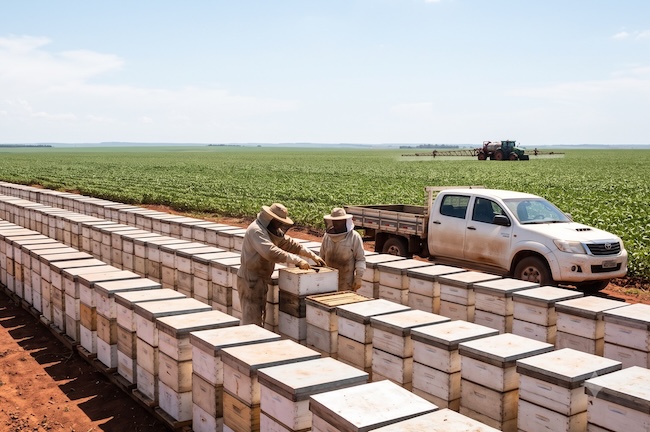
According to the USDA, 78% of the honey Americans consume is imported, and roughly 80% of the honey bearing the organic seal comes from Brazil, admitted under “equivalence agreements” that accept another country’s organic standards as meeting our own.
The USDA and the U.S. Trade Representative have said such arrangements cut duplicate fees, inspections and paperwork. Industry watchdogs, such as OrganicEye, which is backing the lawsuit, don’t dispute that logic, but say organic honey illustrates what happens when the door is left open.
According to the complaint, the USDA lets some foreign suppliers be inspected by agribusinesses that effectively audit themselves. Separately, a paper-only certificate-exchange scheme allows certifiers — with no presence in the country they’re certifying — to approve honey that never met the U.S. bar.
Bruce Kaser, the attorney representing the producers, says consumers who trust the seal “are being defrauded.” The USDA did not address those specific claims.
The complaint’s most sweeping allegation reaches beyond honey: large volumes of organic imports, it says, enter under the U.S.–Canada equivalence agreement without ever passing through Canada — let alone being produced by Canadian farmers — re-papered as Canadian-equivalent in transit so that shipments which could never qualify for USDA organic certification on their own slip in.
The USDA says equivalence means standards are “similar but not identical,” with each government monitoring the other’s.
UNLEVEL PLAYING FIELDS ARE NOT NEW
For anyone who has followed this industry closely, the honey dispute is hardly an isolated case.
What “organic” actually requires has not been uniform for many years — the most blatant example being hydroponically grown produce, which some certifiers permit and others reject outright.
So, if bad actors are exploiting these loopholes as alleged, the fraud in the organic system may be far larger than most people — inside the industry or out — care to acknowledge.
In late 2025, the USDA’s National Organic Program reportedly lost roughly a third of its staff.
Setting aside the merits of this particular lawsuit, one key question remains: does the agency still have the resources to police a global, paper-based certification system?
 | With gratitude,  Max Goldberg, Founder |




Center for Food Safety prevails in fight for transparency on GMO/Bioengineered labels, with new rules expected by January 2028.
George Kimbrell, legal director for the Center for Food Safety, whose lawsuit resulted in this federal court decision, called it “the final nail in the coffin."

Even though organic products generally cost more than conventional, sales of organic items have been rising at aggressive rates, leaving non-organic groceries behind.

The amendment would have restored Americans’ right to sue pesticide manufacturers, but Republicans on the Senate Agriculture Committee on Thursday blocked it from proceeding.

In June, consumers purchased fewer pounds of fresh and processed proteins, including beef, bacon and lamb, as prices continued to rise.

The most comprehensive multigenerational study on glyphosate and Roundup herbicides has found dose-dependent, anxiety-like behavior in rats exposed to doses regulators call “safe”.

Outbreaks of cyclosporiasis are pushing more shoppers to their local farmers markets.
Uber Eats is expanding its retail partners to local and regional stores, including Busch’s Fresh Food Market, Hays, Lowe’s Market, Marc’s and Piggly Wiggly — allowing smaller grocers to compete with national players such as Walmart, Kroger and Amazon.

The initiative aligns with the country’s long-term strategy to improve agricultural productivity, strengthen food security and reduce exposure to volatile global fertilizer markets.
Want to share this newsletter on social media? You can use this link: Newsletter Link