How Organic Insider operates: We accept no advertising, we have no paywalls and we make our newsletters free to everyone because vital information about our industry needs to get out to as many people as possible. Please consider supporting our work, whether you are an individual or a company. Thank you so much.
It is becoming clearer by the day that when it comes to improving the soil in this country, we are increasingly being left to fend for ourselves.
The USDA’s National Organic Program has reportedly had its staff reduced by roughly one-third at the end of fiscal year 2025, according to industry sources. The USDA’s $100 million Transition to Organic Production Program runs out of funding later this year — a particularly worrisome development given that U.S. organic acreage has already declined by approximately 1.5 million acres since 2021.
And now, the agency that plays the biggest role in helping farmers improve their soil is being gutted as well.
According to a recent Politico investigation, the USDA’s Natural Resources Conservation Service (NRCS) — which administers critical programs, including organic transition support through the Environmental Quality Incentives Program (EQIP) — has lost approximately 22% of its staff. Entire counties across Michigan, Wisconsin, Minnesota, Arizona, Florida and South Carolina now operate with skeleton crews or no staff at all.
One Minnesota farmer described the sole remaining officer in his region as “spread so thin that they can’t even think straight.”
Another visited his local office recently and found the lights off. “It looked like a ghost town,” he said.
The irony is that in December, the Trump administration launched a $700 million pilot program administered through NRCS to help American farmers adopt practices that improve soil health, enhance water quality and boost long-term productivity.
U.S. Health and Human Services Secretary Robert F. Kennedy, Jr. declared that “if we intend to Make America Healthy Again, we must begin by restoring the health of our soil.”
But a depleted NRCS will make it exceedingly difficult, if not impossible, to execute on these promises.
PATAGONIA STEPS IN
Into that absence, Patagonia’s nonprofit shareholder Holdfast Collective has stepped forward with a $1.55 million, three-year grant renewal supporting the Rodale Institute’s Regenerate Ventura project — which aims to transform Ventura County, California, one of the state’s most pesticide-intensive counties, from conventional agriculture to organic and regenerative organic farming.
Since launching in 2024, the project has engaged more than 10,000 acres in transition toward a 316,000-acre target, built a pipeline of 57 farms in active transition and moved 12 farms into organic certification application. Rodale Institute agronomists work directly with farmers on crop selection, certification and marketing — while also providing business planning, equipment stipends and legal guidance that government agencies have historically overlooked.
“This renewal reflects what we’ve proven in Year One, that hyperlocal, farmer-first support works,” said Jeff Tkach, CEO of Rodale Institute. “With Holdfast’s partnership, we’re not just funding transition, we’re funding a systems shift.”
“Rodale Institute is filling a void,” said Greg Curtis, executive director of Holdfast Collective. “Their model proves that organic and regenerative organic agriculture is essential to climate resilience and farm viability in our own backyard and beyond.”
WHO ACTS WHEN WASHINGTON RETREATS?
What Patagonia and Holdfast Collective have demonstrated is that waiting for Washington is no longer a strategy. It is a surrender.
Privately financed transition programs like Regenerate Ventura — alongside initiatives from Mad Capital, Iroquois Valley Farmland REIT and others — are no longer optional. They are essential. And the organic brands whose supply chains depend on transitioning farmers must now commit to deep, long-term partnerships with the farmers who make their businesses possible.
This administration made a promise to restore the health of America’s soil, and by dismantling the very agency responsible for delivering it, Washington is walking away.
The organic industry cannot afford to do the same.
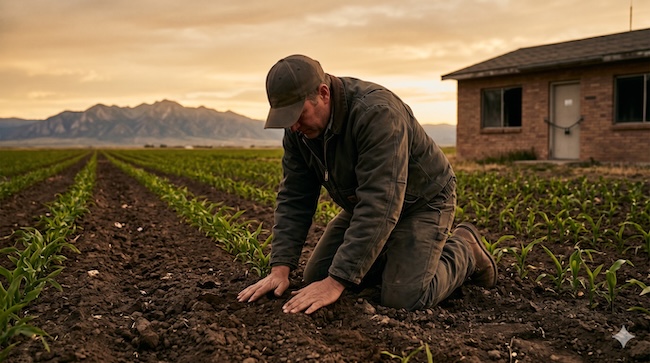
The soil will not wait — and neither will the farmers standing in it.
 |
With gratitude, 
Max Goldberg, Founder |


The owner of Suja Organic, Vive Organic and Slice Soda grew 2025 revenues to $326.6 million, up from $258.9 million in 2024.
This groundbreaking 10-year study found that farming with zero pesticides of any kind — including biological and organic-approved inputs — is both profitable and productive, with yields in some cases matching or exceeding conventional chemical farming.

After having reviewed a report from Friends of the Earth about the toxic impact of no-till agriculture, Andrew Smith, PhD, chief scientific officer at Rodale Institute, wrote that he rejects "the use of the word 'regenerative' to describe any form of agriculture that intentionally pollutes the environment, makes people sick, and misuses and abuses livestock, farmers, and farm workers."

Preventative health and the food-as-medicine movement are the main drivers of this spending surge, and club stores, not natural products retailers, are leading the pack as go-to destinations for these shoppers.
If this new office attempts to implement organic rules for seafood, it would be a disaster for our industry.

Whether anything concrete comes from this remains to be seen.

This marks the second major deal in six weeks for Laird Superfood, and private equity firm Nexus Capital Management now owns roughly 71.7% of the company on a fully diluted basis.

According to the lawsuit, SweetLeaf Monk Fruit Organic Sweetener — marketed as "sweetened by nature" with "nothing artificial" — is actually 99.13% erythritol, with monk fruit extract comprising less than 1% of the product.

Retailers are using AI to gain insight into consumer behaviors, such as identifying what products will sell, at what price and at what point in their shelf life.
Want to share this newsletter on social media? You can use this link: Newsletter Link