How Organic Insider operates: We accept no advertising, we have no paywalls and we make our newsletters free to everyone because vital information about our industry needs to get out to as many people as possible. Please consider supporting our work, whether you are an individual or a company. Thank you so much.
Something is happening on social media that demands a direct response.
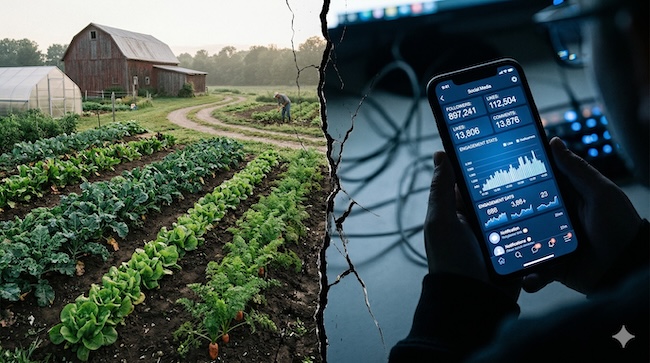
A growing number of very large content creators, influencers and self-appointed food experts on Instagram have been attacking organic with increasing intensity — calling it “the greatest gaslight of all time,” “worthless,” and “a scam.” They present themselves as truth-tellers cutting through industry propaganda.
They are not. And it is time to say so plainly.
This is not a good-faith critique of a flawed system. When it comes to presenting an alternative farming method to organic, no better framework is proposed and no constructive path forward is laid out. There is only destruction — and the monetization of that destruction. Every click, every share, every outraged comment helps to put money in their pocket. Organic is simply the vehicle. They do not appear to care about it at all.
What these influencers fail to grasp is that the organic system they are tearing down governs with federal certification, soil standards, a prohibition on synthetic pesticides and genetically-engineered ingredients, annual certifier inspections, chain-of-custody requirements and fraud enforcement. Tens of thousands of farmers, certifiers, inspectors and brands operate within these agreed rules every single day.
And if organic were to disappear, what would we be left with?
The conventional food system:
* A system where everything can be sprayed with glyphosate, a weedkiller that causes cancer, and dicamba, an herbicide so damaging that the U.S. Court of Appeals for the Ninth Circuit said it has “torn apart the social fabric of many farming communities.”
* A system where genetically-engineered foods and synthetic biology ingredients — novel genetic combinations that have bypassed millions of years of evolutionary development — enter our bodies with no meaningful accountability.
* A system optimized to produce food as cheaply as possible, with the true cost externalized onto farmers, communities and the environment.
* A system where conversations about soil health, animal welfare and seed sovereignty simply end — because the only goal of industrial agriculture is profit, and profit alone.
These influencers calling it a scam will never spend a day on an organic farm.
They will never look a fourth-generation farmer in the eye — someone who has spent years earning certification, paid thousands in annual fees, worked without synthetic shortcuts and done it not for the money, but because they believe the world deserves better food — and tell them to their face that what they do is worthless. That their life’s work is a gaslight.
But that is exactly what these people are saying.
When organic farmers lose markets, their farms fail. When their farms fail, they do not come back. There is no version of this story where tearing down organic makes anyone’s life better — except the person monetizing the outrage.
Organic is not perfect. Enforcement must be stronger. Fraud must be eliminated. Organic Insider has said all of this and will continue to say it — because the system is worth fighting for.
But there is a profound difference between demanding a better organic system and burning it down with nothing to replace it.
One approach serves farmers, consumers and the planet. The other serves only the person holding the camera.
 |
With gratitude, 
Max Goldberg, Founder |

Thanks to the work of Diana Reeves and GMO/Toxin Free USA, the FDA has indefinitely delayed the approval of GMO beetroot red food color via precision fermentation — something we warned about last September.

Organic produce accounts for 13% of total retail produce sales, 1% higher than in 2024, and 8% of overall produce volume, also 1% higher than the year prior.

A group of international scientists determined that evidence showing glyphosate herbicides can harm human health “is now so strong that no additional delays in regulation of glyphosate can be justified.”

Rep. Chellie Pingree (D-ME) and pesticide/MAHA activist Kelly Ryerson jointly pen an op-ed in The Hill on why Big Chemical should not be above the law.

Even though Mt. Folly Farm grows its own fertilizer and uses compost, this regenerative organic farm in Kentucky faces other challenges, namely diesel fuel costs for shipping and its tractors.

A coalition of consumer, public health, sustainable agriculture and conservation organizations represented by Center for Food Safety filed a brief in the U.S. Supreme Court case Monsanto v. Durnell explaining why state efforts to warn the public about pesticides' health hazards must not be eliminated.

Three months into 2026, the agency has still not indicated when those funds might be made available, something that could push many small farmers out of the organic system entirely.

If a greenhouse can't maintain adequate CO2 without synthetic supplementation, does this production system even belong in organic?

A new California bill seeks to establish a state certification program for non-ultra processed foods (UPFs), which would potentially put it in competition two private certifications: Non-UPF Verified and WISEcode.
Want to share this newsletter on social media? You can use this link: Newsletter Link