
How Organic Insider operates: We accept no advertising, we have no paywalls and we make our newsletters free to everyone because vital information about our industry needs to get out to as many people as possible. Please consider becoming an Organic Insider+ subscriber, whether you are an individual or a company. Thank you so much.
On September 19, the Real Organic Project held its annual symposium at Churchtown Dairy in Hudson, New York. Here are my five key takeaways.
APPEARANCE BY MEMBERS OF CONGRESS MAKES A REAL STATEMENT

(On the left, Dave Chapman, co-director of the Real Organic Project, interviews U.S. Representatives Chellie Pingree and Thomas Massie.)
U.S. Representatives Chellie Pingree (D-ME) and Thomas Massie (R-KY) shared the main stage — a rare bipartisan pairing that signals how far healthy food has moved up the agenda in Washington, D.C., and how much clout the Real Organic Project now carries.
“We talk about a lot of issues, but we do not talk to politicians about food,” said Rep. Pingree, an organic farmer, urging people to make food a priority with their elected officials. She made the same plea about toxic chemicals.
“The door is opening now — as it relates to glyphosate, paraquat and PFAS — and we have to make a full-court press. It is our moment in time.”
Rep. Massie, a cattle farmer, shared a tip for influencing lawmakers when calling into D.C.
“When an intern answers, ask to be connected with the legislative assistant handling ag policy, and be very nice to that person.”
The Republican from Kentucky also said that because of what he learned at the symposium (more on that below), he is “going to go home and take Driscoll’s off the menu.”
A JARRING VISUAL
The Real Organic Project was founded largely in response to the USDA’s continued allowance of hydroponics in organic, which the National Organic Standards Board cemented in 2017 when it refused to recommend against the practice.
As we have argued extensively, hydroponics in organic violates section 6513 of the Organic Foods Production Act, a federal law passed by Congress. It also forces soil-grown organic farmers to compete on an unlevel playing field, which has pushed some of them out of the industry altogether.
During his presentation, Hugh Kent, a Real Organic Project-certified blueberry farmer at King Grove Organic Farm, showed how some large hydroponic operators grow organic produce: in plastic bags filled with coconut coir — a fiber made from coconut husks.

That image (above) hit home — more than the many images of plastic-covered hydroponic fields I have seen over the years.
Although regenerative organic is getting unprecedented attention these days — a very good thing — there is relatively little outrage that our organic berries, tomatoes, greens and cucumbers are increasingly being grown without soil. Hydroponics, or soilless growing, is anathema to what regenerative represents.
And all that plastic comes at a cost.
“All of these plastic pots and bags time out in four to five years when the plants get root-bound, and everything gets thrown out, including the black plastic ground cover that cannot be recycled,” said Kent. “It’s a shame that people are continually advised to seek out organic food, but they aren’t told there are two kinds of organic: soil-grown and these hydroponic, plastic-intensive growing systems that are taking over many crops. I just don’t believe they produce the same kind of food.”

WHAT WE ARE UP AGAINST
Two presenters offered an inside look at the tactics the chemical industry uses against its critics.
In 1997, UC Berkeley professor Tyrone Hayes was hired by a consulting firm working for Novartis to study the safety of atrazine, an herbicide that came under Syngenta’s ownership when Syngenta was formed in 2000. His research, however, found that atrazine was linked to turning genetically male frogs into functional females, and the relationship with Syngenta soured.

Syngenta responded with an aggressive, multiyear campaign to discredit and monitor Hayes.
“My science was so good…I can show you these documents they wrote down: investigate his mother, investigate his father, investigate his wife, investigate his students,” he told the audience.

(Notes unsealed in a 2012 water lawsuit settlement show company officials wrote: ‘Discredit Hayes.’)
Harvard professor Naomi Oreskes detailed the ghostwriting behind what is arguably the most influential glyphosate safety paper ever published.
A 2000 review concluding that Roundup posed no human health risk was widely cited by regulators. It remained so even after the 2017 Monsanto Papers litigation revealed that Monsanto employees had secretly ghostwritten it. Oreskes and researcher Alexander Kaurov found that the paper still ranked in the top 0.1% of cited glyphosate literature.
After Oreskes and Kaurov formally requested a retraction, Regulatory Toxicology and Pharmacology pulled the paper in November 2025, citing undisclosed corporate ghostwriting and reliance on unpublished company data.

HUNGER STRIKER TAKES ON DRISCOLL’S

(Omar Dieguez holding up a GMO/Toxin Free USA T-shirt that reads “Don’t Let Driscoll’s Berry Our Children in Toxic Pesticides”)
Driscoll’s is facing a class action lawsuit alleging it failed to disclose PFAS in its strawberries and a wrongful termination lawsuit alleging it ignored pesticide laws.
It is also up against a local activist named Omar Dieguez.
As profiled in Organic Insider last year, Dieguez went on a 30-day hunger strike to protest the spraying of toxic chemicals near schools on fields that grow for Driscoll’s in Watsonville, California, the company’s hometown.
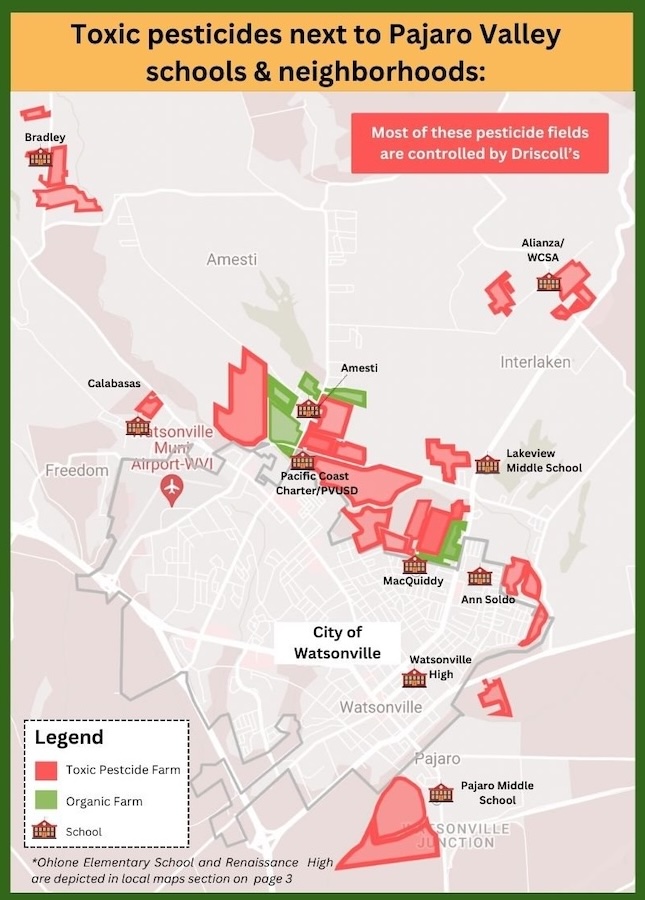
Dieguez gave a firsthand account of what he has seen.
“I sat with farmworkers throughout this hunger strike, and I don’t know how many stories I heard…of farmworkers saying ‘My mother passed away from pesticides, my father passed away from pesticides, my kids are suffering from pesticides’…I have seen the scars of farmworkers…I met this lady who had her stomach removed from working in the fields, and her kids are suffering from learning disabilities and birth defects and so on and so on. It is something that needs to change.”
IS IT ALL ABOUT YIELDS?
While organic conferences tend to be one-sided, the debate between UC Berkeley agroecologist Tim Bowles and journalist Michael Grunwald was a welcome change.
Grunwald is the author of We Are Eating the Earth, and his central thesis is that yields matter above almost all else. Producing more food on less land, he argues, is the best way to protect forests and the climate. Critics say that framing sidelines farmworker health, pesticide exposure and soil health.
“The math is really ugly,” he said, citing FAO estimates that the world will need 50% more calories by 2050.
Bowles countered that higher yields create induced demand: lower prices simply drive up consumption. “Cheap food is not an anti-hunger policy,” he argued.
For me, Grunwald’s case collapsed when he said that nutrition does “not have that much to do with how food is grown.”
Grunwald may not have changed many minds, but at a time when respectful debate is increasingly rare, he sharpened the conversation and made the symposium better for it.


(With Eliot Coleman — organic farming icon, author and founder of Four Season Farm in Maine.)

(From l. to r., with Professor Tyrone Hayes and Kelly Ryerson, co-founder of American Regeneration)

(From l. to r., after our breakout session panel, activist Omar Dieguez and scientist Dr. Chuck Benbrook.)
 | With gratitude,  Max Goldberg, Founder |




While details are scant, the Democrat from Maine and organic advocate said she will soon be a founder of a new bipartisan “Fix Our Food” caucus.

The producer of organic functional shots and SuperAdes plans to use the funding to expand across retail and foodservice.
Following its acquisition of Chameleon Cold Brew, Next in Natural has purchased Three Trees, a maker of organic, plant-based milk.
Organic sales reached $76.6 billion in 2025, but Whole Foods CEO Jason Buechel says supply constraints, producer economics and price perceptions could determine how quickly the market reaches $100 billion.

Farmers nationwide are increasingly turning to cooperatives and collective purchasing power to build resilience.

Cerebelly, a manufacturer of organic baby and children’s food designed to support brain and cognitive health, has acquired Fresh Bellies, a sugar-free children’s food brand.

The voluntary label can be used on products that do not fall under the state’s definition of ultraprocessed foods, established in 2025.

Rice and other cereals fraudulently marketed as ‘organic’ have resulted in the seizure of assets worth over 10 million euros.

"Organic farmers are competing against a flood of food marketing dollars, but they hold something no ad budget can buy: a real story about how their food is grown and why it matters,” said Madison Letizia, communications manager for the Organic Farmers Association.
The pioneering organic foods brand will eliminate approximately 260 jobs as it streamlines its manufacturing network amid category-wide headwinds.
Want to share this newsletter on social media? You can use this link: Newsletter Link